


Xaira is trying to build something more ambitious than a single AI model for biology. The company’s wager is that drug discovery improves when protein design, large-scale perturbation biology, foundation models, and therapeutic development are built as one tightly connected system rather than as separate tools or organisations.
That broader ambition came into sharper focus in March 2026, when Xaira released X-Cell, a 4.9 billion parameter diffusion model for predicting cellular responses to genetic perturbation. X-Cell is not the whole platform, but one important layer within it: a model designed to help infer which perturbations matter, in which contexts, and where experimental follow-up may be most valuable.
In this conversation, we explore:
Why Xaira believes advantage comes from integrating data generation, model-building, and drug discovery execution rather than optimizing any one layer in isolation.
What X-Cell has shown on out-of-context generalization, and where interpolation may still be mistaken for transfer.
What the emerging scaling laws in perturbation biology may mean biologically, not just statistically.
Why biological diversity, not just model size, may be the critical axis for progress in virtual cell systems.
How Xaira thinks about the validation loop from model prediction to wet-lab testing and eventual therapeutic relevance.
What it takes organizationally and technically to turn a virtual cell model into part of a real drug discovery engine.

Overview
Xaira Therapeutics launched in 2024 with more than $1 billion in funding to rebuild drug discovery end to end using AI. Co-founded by Nobel laureate David Baker and incubated by ARCH Venture Partners and Foresite Labs, the company is assembling protein design, large-scale biological data generation, foundation models, and wet-lab validation into a single loop, with the aim of making discovery faster, more iterative, and more predictive.
In practice, that means combining generative protein design, perturbational and multi-omic data generation, foundation models across biology, and the translational machinery needed to turn those systems into actual drug programs. The leadership includes CEO Marc Tessier-Lavigne, former CSO of Genentech and former president of both Stanford and Rockefeller, alongside a team of veteran drug hunters, frontier ML researchers, and high-throughput biology specialists.
X-Cell
In March 2026, Xaira released X-Cell, a 4.9 billion parameter diffusion language model for predicting how cells respond to genetic perturbations. X-Cell is one layer in Xaira’s larger stack: if protein design models aim to create therapeutic molecules, X-Cell is aimed at modeling cellular state and helping determine which perturbations matter, in which biological contexts, and potentially which hypotheses are worth testing next.
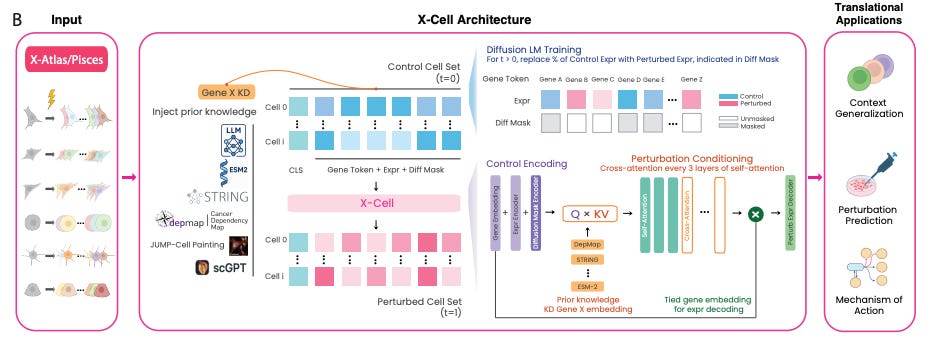
Trained on X-Atlas/Pisces, the largest genome-wide CRISPRi Perturb-seq dataset ever reported (25.6 million perturbed single-cell transcriptomes across 16 biologically diverse contexts), X-Cell departs from the autoregressive architectures that have dominated the single-cell foundation model space. Instead, it iteratively refines predictions through a masked diffusion process and incorporates diverse biological priors (protein language models, gene interaction networks, genetic dependency maps, morphological profiles, and natural language gene descriptions) via cross-attention. Xaira reports state-of-the-art performance including zero-shot generalization to cell types never seen in training, and claims perturbation prediction follows power-law scaling dynamics consistent with large language models.
The release arrives at a moment of both excitement and scrutiny for the virtual cell field. Multiple benchmarking studies published in 2025 showed that existing single-cell foundation models, including scGPT and scFoundation, have not outperformed simple linear baselines on perturbation prediction tasks. The central open question is whether these models are learning transferable biological logic or performing sophisticated interpolation over their training distributions.
Our guests
In this interview, we speak with Ci Chu, SVP of AI-Enabled Discovery, and Bo Wang, SVP and Head of Biomedical AI, about what X-Cell has actually demonstrated, where the limits of generalization lie, and how Xaira plans to turn a virtual cell model into a drug discovery engine.
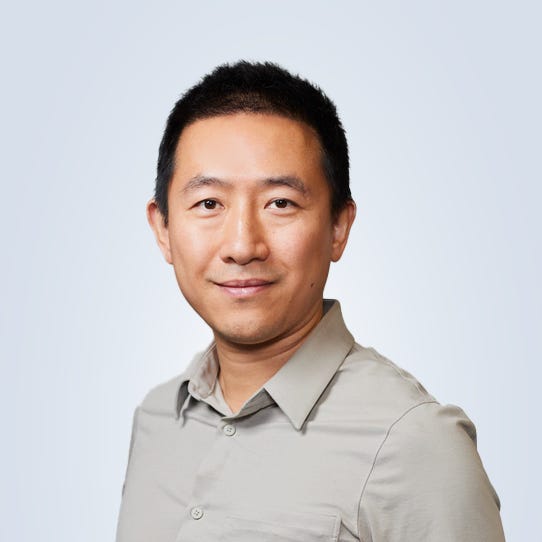
Chu has spent more than a decade working at the intersection of high-throughput biology and AI-driven discovery. Before Xaira, he led advanced cellular technologies at insitro, where he ran high-content phenotyping and functional genomics programs using human iPSC disease models and machine learning. Earlier, at Google[X]/Verily, he co-developed the Immune Profiler platform, which was used in a $90 million collaboration with Gilead on autoimmune disease. He completed his PhD at Stanford in Howard Chang’s lab, where he invented ChIRP, a widely adopted method for studying long non-coding RNAs, and identified key regulators of X-chromosome inactivation in female cells.
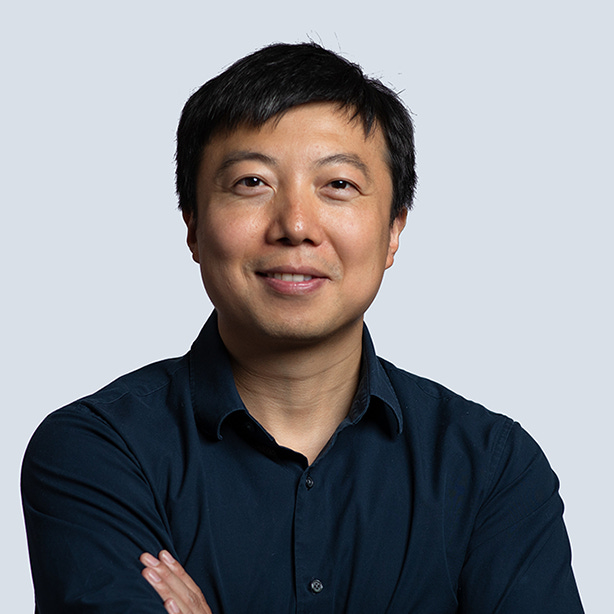
Alongside his position at Xaira, Bo Wang is also an associate professor at the University of Toronto. Trained in computer science at Stanford, he works on AI for biology and medicine, with a focus on foundation models, multimodal learning, and biomedical prediction. His recent work spans genomic analysis, precision medicine, and biomolecular modeling, and has helped establish the use of large-scale AI models in healthcare and biology.
A Conversation with Xaira’s Bo Wang and Ci Chu
PART 1: XAIRA AS A COMPANY
Zahra: Xaira launched in 2024 with this very broad end-to-end discovery mission. Where do you see the biggest source of advantage coming from over time? Is it the data, the models, the experimental platform, or the integration across all of them?
Ci Chu: It’s the integration of all of the above. Xaira is quite unique in that we have expertise across three areas. First, there is deep drug discovery experience. For example, our CSO Debbie Law previously led biotherapeutics at Bristol Myers Squibb, and our CEO Marc Tessier-Lavigne was CSO of Genentech. Second, we have frontier AI talent, including people like Bo and Hetu on the protein design side. Third, on the biology side, we are building large-scale data generation, which is the group I lead. It is rare to find a company that is strong across all three. What sets Xaira apart is not any one piece in isolation, but the fact that data generation, advanced models, and real drug discovery execution are being developed and integrated together.
Bo Wang: That combination matters because one of the biggest problems in drug discovery is fragmentation. Models are often built far from the experimental systems and therapeutic decisions they are supposed to inform. What drew me to Xaira was the chance to work in a place where AI, biology, and real drug development are tightly connected. The goal is to use AI across the full discovery process, not as a standalone tool, but as part of an integrated system.
Zahra: What has turned out to be the hardest part of building Xaira in practice, not just scientifically but also organizationally and strategically?
Ci Chu: The hardest part is turning integration into something real. It is one thing to have biology, AI, and drug discovery in the same company. It is another to get them to operate as one system. That means helping each group understand the others’ constraints and tools, whether that is what AI-ready data looks like, what experimental limits matter, or how foundation models can actually be used in discovery. Without that shared language, work just gets handed across functions without real collaboration.
Bo Wang: That challenge is even harder across multiple sites in South San Francisco, Seattle, and London. What we are trying to build is a closed loop in which models make predictions, the wet lab tests them, and those results improve the next round of models. That only works if teams are tightly connected. Xaira has tried to build a science-first company around that. We have internal tutorials, science 101 sessions, cross-functional weekly sci-sync meetings, journal clubs, poster sessions, and invited speakers. Some of that is about teaching, some of it is about creating a common language, and some of it is simply about making sure people are regularly exposed to work outside their own function. The aim is to make collaboration operational, not just aspirational.
Zahra: Is there anything Xaira does differently that helps create that cross-functional coherence?
Ci Chu: The main difference is that we invest real time in it. There is no shortcut. People from very different backgrounds are not going to automatically understand each other’s language or workflows. So we put thought into how meetings are run, how teams interact, and how to keep functions from drifting into silos.
PART 2: X-CELL, GENERALIZATION VS. INTERPOLATION
Zahra: A lot of the strongest perturbations in the paper seem to affect core cellular functions that many cell types might respond to similarly. How much of X-Cell’s performance in new cell types do you think is coming from broadly shared responses versus cases where the effect really depends on the specific cell type?
Ci Chu: We see both. Some perturbations behave very similarly across contexts. These tend to be housekeeping mechanisms. Mitochondrial ribosomes are one example. Those pathways do broadly similar things in different cell types.
But we also now have the chance to discover what we call context-dependent perturbations.
These are genes that may be expressed across all seven cell types, but when you perturb them, they have different secondary effects depending on the context. That also makes a lot of biological sense. The ones we found to be unique to iPSCs or primary cells are involved in development and differentiation, which makes sense. We even discovered that Complex I, which is important for oxidative phosphorylation and energy production, seems to behave differently between primary cells and cancer cell lines. Again, this conforms to known biology.
So we are seeing both things: (1) perturbations that act similarly across context (2) perturbations whose effects really depend on context.
The second category is especially important for drug discovery. We do not want to target mechanisms that are pan-essential across all cell types, because that is where you get toxicity and side effects. We want mechanisms that are specific to the pathology and cell type in question.
We specifically tested this kind of generalization in activated T cells. The model was trained on perturbation data from resting Jurkat T cells and then asked to predict knockdown effects in activated Jurkat T cells, despite not having seen perturbation data from that activated state during training. These genes should behave very differently across the two states: in activated T cells, knocking them down should push the cells back toward a more resting-like transcriptional state. X-Cell was able to recover that effect for the TCR complex as well as for several putative T-cell activation genes.
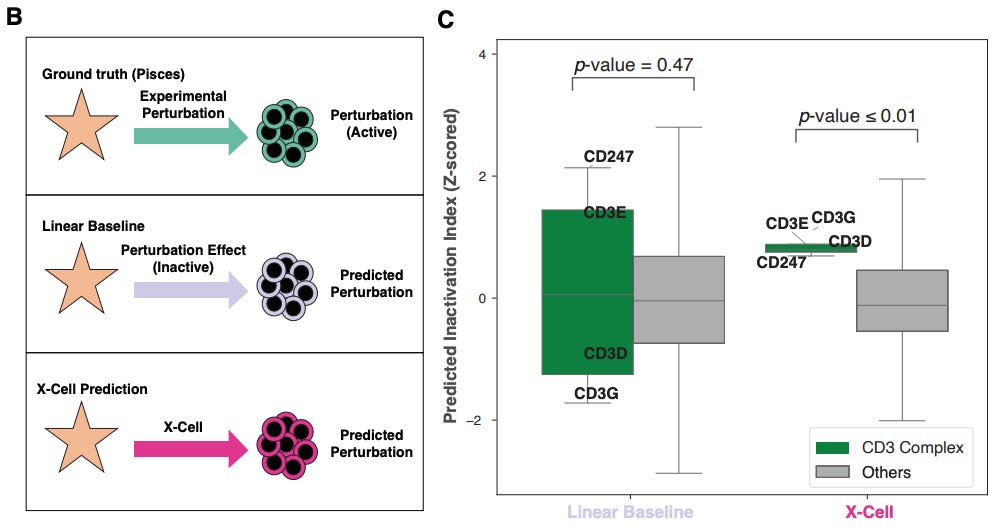
That was very impressive to us, because the model is able to generalize out of context, on context-dependent and some very difficult perturbations to get right. So we think we’re generalizing not just to pan-essential genes but through context-dependent perturbations as well.
Zahra: How should we think about those held-out examples as tests of generalization? For instance, is going from resting to activated T cells a genuinely strong transfer test, or still a relatively local one?
Ci Chu: We tried to test generalization at a few different levels.
In the activated T-cell setting, the model was trained on resting Jurkat cells and then asked to predict perturbation effects in activated Jurkat cells. The key point is that we were not just looking at generic genes. We focused on genes that matter specifically for activation, like components of the TCR complex. Those effects should not be easy to infer from the resting-state data alone, so we saw that as a meaningful test of whether the model could generalize to a new cellular state.
In the melanocyte progenitor case, we used a pan-lineage iPSC differentiation screen and held out one lineage entirely. The model never saw perturbations in that lineage during training, and then we tested it on more than a thousand perturbations in that unseen context. That made it a much broader test than a single illustrative example.
The primary T-cell result is slightly different again. There, the question was whether a model trained largely on more tractable cell-line data could transfer to a much harder primary-cell setting, where exhaustive screening is much less practical.
So the tests are different in character, but in each case the goal was to ask whether the model could carry useful information into a context where direct perturbation data was missing.
Zahra: Have any of these out-of-context findings been followed up on or seemed translationally useful for Xaira?
Ci Chu: Absolutely, the team is following up on some of those findings, but these are putative ideas for now. They need to go through rigorous lab validation using independent technology, independent assays, independent biological systems. If they pan out, we’ll be very curious to get into their therapeutic potential for next steps.
Zahra: Is that validation loop something Xaira has built out, like an agentic workflow or lab-in-the-loop? How does Xaira think about validating findings from its AI models?
Bo Wang: We are certainly working on next-level agentic AI. Can an agent actually validate some of the findings from different AI tools like X-Cell, or even suggest certain validations to further confirm findings? That’s definitely the next step.
Zahra: So far, the work is still being evaluated on held-out datasets. Looking forward, where do you think X-Cell could become most useful as a practical discovery tool?
The most exciting direction is in systems where exhaustive screening is not realistic. In cell lines, you can still generate large perturbation datasets directly. But in organoids, animal models, and other higher-fidelity systems, exhaustive screening is much less practical and the experiments too expensive. That is where a model like X-Cell could become genuinely useful, not by replacing experiments, but by narrowing the space and helping us decide what is worth testing first. Even if it only improves the hit rate by tenfold or hundredfold over brute-force screening, that would already make a major difference. The real opportunity is to use it to explore biology that is currently out of reach experimentally.
PART 3: SCALING LAWS
Zahra: Moving to the scaling story. What do you think these scaling curves are telling us biologically, rather than just statistically?
Bo Wang: The scaling laws we see here are more complex than in language or image models. In biology, the axes are more complicated. It is not just the number of parameters. You also have the number of cells, the diversity of cell types, and the diversity of biological contexts.
What we did here was a simplified scaling-law analysis focused on parameter size. We found that as you scale the number of parameters, both training loss and validation loss improve. So, given a fixed but diverse dataset, increasing model size does improve performance.
The more important question, though, is whether we can characterize scaling along the axis of biological diversity. We did a little of that in the original scGPT work, where we found that increasing the number of cells improved performance up to a point, after which it saturated at around 3 million cells. But that was on expression datasets.
We have actually never done a comprehensive scaling law on causal datasets such as Perturb-seq, for many reasons. Before Pisces, we actually didn’t have much Perturb-seq data. Nobody has done a comprehensive scaling law on that. It’s definitely on our to-do list.
Even with Pisces, although it’s the largest-scale dataset, the number of contexts is still limited to 16 cell types, and those are still just cell lines. I can almost guarantee, without doing experiments, that the more contexts we have, the better the performance will become. We already see massive improvements just by comparing X-Cell Ultra, trained on all contexts, with the original X-Cell Mini, which has 50 million parameters and was trained on fewer contexts.
Characterizing the scaling law on the axis of biological diversity is still early work, mostly due to data limitations.
Ci Chu: Which is to say I need to go back to the lab!
Zahra: Why should scaling work at all in perturbation biology, where the data is so much sparser than in language?
Bo Wang: With sparse perturbation data, you’d expect bigger models to just memorize. This is exactly why we designed specific engineering choices to prevent that: the iterative diffusion process, where each refinement step provides context for the next, and the injection of biological priors, which ground the model. Without those, scaling to 5 billion parameters on a shallow dataset would just produce memorization. The large, high-quality Pisces dataset provides the playground to even test the scaling law.
Ci Chu: On the data side, we’re scratching the surface. With seven screens and 16 contexts, we already see context-specific perturbations, which bodes well. If every perturbation did the same thing in every context, there’d be no reason to scale further.
But “scaling across context” usually just means more cell lines. That’s only one axis. You can imagine putting cells in hypoxia, different temperatures, different media, pathway activators or inhibitors. Even for one cell type, the number of possible contexts is enormous. Multiply by biological diversity and multicellular systems, and the space is endless. Just like AlphaGo didn’t need to brute-force every move, we hope AI models can help navigate biological complexity without exhaustive experimentation.
Zahra: What are the primary bottlenecks around data generation?
Ci Chu: X-Atlas/Pisces is our current generation. It’s more than three times the size of Orion, the previous instalment. It’s much more diverse: Orion was just two cell lines, now we have seven screens and 16 contexts.
Even in that dataset alone, by computational analysis, we can see increasing biological recall of known biology as you increase the number of contexts and screens. In Figure 2, going from one screen to seven screens, you see monotonically increasing recall of known protein-protein interactions and complexes from STRING DB and CORUM. Even if you hold the number of cells constant, your recall is still better if you do more screens than fewer, more contexts than fewer. It’s pretty clear and intuitive, but now we have numbers to show it.
What is not trivial is scaling data generation to that level of diversity. You might think that once you can do two cell-line screens, you can do 200. But each of these campaigns is large and laborious. On harvest day, we are talking about hundreds of millions of cells and a huge coordinated effort across the team.
Biology is also messy and highly variable from one cell type to the next. For example, HepG2 cells are very fragile. They are almost like water balloons. If you treat them too harshly, they burst. You can literally see fluorescent protein leaking out and RNA content being lost. So we have to handle them extremely carefully and apply rigorous quality control.
This is actually why, after optimizing conditions for a few cell lines, when we were ambitious enough to take on the multi-lineage differentiated iPSC experiment, we realized we cannot easily handle all the different cell types in a single screen using the same method. So we innovated and introduced a new way to do Perturb-seq: the 10x Flex Probe-based Perturb-seq, which uses a harsher chemical fixation with formaldehyde. Because gene expression detection is done by probe, it’s compatible with fixation. Thanks to that, we can now harvest all different cell types in a single experiment without bias.That let us harvest very different cell types in one experiment without introducing bias. There is a lot of technical innovation and attention to detail involved in moving from simple cell lines to higher-value systems.
Zahra: Is doing Perturb-seq on mouse or in vivo data on the roadmap?
Ci Chu: Absolutely, that’s currently under active development and hopefully we’ll have exciting news to share soon.We are definitely moving toward in vivo work at Xaira. The clear advantage is that cells are in their physiological context, so perturbations become more meaningful. A receptor for a ligand that is not present in vitro may show no phenotype when you knock it down in culture, but it could matter strongly in the right in vivo setting.
Of course there are a lot of challenges. How do you deliver CRISPR, both the enzyme and the guide RNA, effectively to the organ of interest? How do you avoid all the technical difficulties harvesting cells in a timely manner so RNA doesn’t degrade? We’re working through all of those issues.
Zahra: What about combinatorial perturbations?
Bo Wang: This is a key reason I believe scaling laws will be useful. We haven’t even touched combinatorial perturbations. Most of us do single-gene perturbations. With X-Cell, we can simulate multi-gene perturbations in silico by masking two tokens simultaneously. It’s easy on the computer, but we have very little ground truth to validate. That’s a massive unexplored space, and we’re internally very interested in this direction. The number of combinations is so large that you can’t experimentally exhaust them. This is where the virtual cell will provide very useful predictions.
Ci Chu: Bo may already be showing promising signals. If you broaden “combination” to include pathway activation plus genetic perturbation, the Jurkat activation results are telling. The naive approach of adding predicted effects in inactive T cells onto the activated baseline doesn’t work. But X-Cell seems to combine the activation signature and the perturbation prediction in a nonlinear, combinatorial way and make accurate predictions. We’re already seeing early signs and are curious to take this further.
PART 4: ARCHITECTURE
Zahra: Staying with the generalization question, what in the architecture do you think matters most for helping X-Cell transfer to unseen contexts?
Bo Wang: Two things mattered most. The first was moving away from autoregressive training. That approach made sense in earlier models like scGPT as a self-supervised objective, but it is not a natural fit for single-cell data because genes do not have a true sequential order the way words do in language. In X-Cell, we moved to a diffusion language model, which iteratively refines the prediction without imposing an artificial ordering over genes, and we found that this improved generative performance and generalization. The second was incorporating a broad set of biological priors, including literature-derived information, protein-protein interactions, DepMap, and morphology, which gives the model much richer grounding when it has to make predictions in settings it has not directly seen.
Zahra: The cross-attention mechanism incorporating biological priors is really interesting. DepMap and STRING seemed most important in your ablation studies. Can you talk through the inspiration for that architecture and why those priors mattered most?
Bo Wang: The idea of incorporating biological priors is not novel, but we found almost every existing method uses a single source. GEARS uses gene regulatory networks, scGPT uses literature, CellSentence uses language.
When designing X-Cell, we wanted to incorporate diverse priors and let the model learn which ones matter most. Since we’re already using transformers, using attention to assign weights was a natural choice. We project every prior into the embedding space and use cross-attention at each layer of the diffusion transformer.
It works well and provides interpretability. DepMap is useful because it thoroughly characterizes essential genes for cancer datasets. PPI is useful because it captures dynamic interactions between genes. Literature helps because it encodes known biological conclusions. This is also dataset-dependent: at test time, you can monitor how attention weights shift across priors, which gives mechanistic interpretation for specific cell lines.
Looking ahead, we’re thinking about multimodal foundation models that generate other modalities beyond RNA for more specific context, rather than relying only on general priors.
Zahra: How do you see virtual cell architectures evolving? Could it become a system of specialized models rather than one unified model?
Bo Wang: Since scGPT, almost every virtual cell model uses transformers, partly because they’re widely used and well-supported by existing code bases. I don’t believe this is the ultimate architecture. There are innovations like Mamba and Hyena that are more efficient but haven’t shown better generalization yet. Meta recently published work on Attention Residuals that changes how layers propagate gradients. There’s a lot of innovation happening in general AI. It remains to be tested in biology contexts, but so far transformers seem to be the right choice.
PART 5: ROADMAP AND BROADER XAIRA STRATEGY
Zahra: Your roadmap includes primary cells, organoids, and in vivo settings. Which transition is hardest and which offers the most scientific value?
Ci Chu: It depends on the goal. For a broad foundation model of biology, you need to sample many cell types and contexts. For target discovery in a specific indication, which is high value for us as a drug discovery company, the most useful data often comes from the most relevant biological system.
That is where we are headed. We have disease areas of interest internally and are spending a lot of time thinking about primary-cell, organoid, and in vivo models. There will be many new technical challenges, but high-value targets come from both high-diversity screening and high-fidelity disease models. The more carefully we can construct systems that reflect the pathology, etiology, and molecular triggers of human disease, the better the data generation platform becomes.
Zahra: Is there a path to platform economics beyond the drug pipeline?
Ci Chu: We are a drug discovery company. We will develop our own targets, our own drugs, and take them to the clinic. At the same time, we are also an AI company, and we are open-minded. If there are platform economics around our AI tools, whether virtual-cell models, protein design models, patient representation models, or agentic AI, then we would absolutely collaborate. After the Orion data release, multiple commercial entities reached out about data access, which was a pleasant surprise.
Zahra: What problem do you wish the rest of the community would solve?
Bo Wang: I hope the community becomes more united. We need more shared datasets and more collective progress in model building so that the field can move faster. On the protein side, we saw huge success with AlphaFold, enabled by broad contributions of structural data. I would love to see something similar happen for virtual-cell models. Pool the cellular datasets, build better models, and create more shared intelligence. It is still very early, and the field needs far more collective effort.
Ci Chu:I agree. I would also love to see continued engagement between drug developers and people working on AI innovation, so that both sides can think together about where these models actually perform well and where they can bring unique value. It is not always easy to find the right product-market fit, and that takes real input from both communities.
Zahra: A great note to end on: not just how to build better models, but how to build the kind of field that makes better models possible. Thank you both.