

BioByte 168: Prime Predictions, Engineering Cancer Circuitry, Programmable Plants, and the Hidden Learning That Lies Within NMR


A couple updates: We are hiring a lead reporter to cover all cutting edge news in biotech! Learn more about the position and application process here.
We will be pausing BioByte for a few weeks as we refresh the newsletter. We’ll be back in your inbox in early September with an exciting new format—see you soon, Decoders! 👀

What we read
Papers
Mechanistic machine learning for prediction of prime editing outcomes [Hsu et al., Nature Biotechnology, August 2026]
Why it matters: OptiPrime is a machine learning model that predicts prime editor efficiency based on a mechanistic formulation of prime editor guide RNA (pegRNA) function and associated cellular processes. OptiPrime achieves state-of-the-art performance on out of distribution prime editor types and shows promising results in optimization campaigns for prime editor design in mouse models.
Prime editing (PE) precision gene-editing tools have greatly expanded potential treatment options for various genetic diseases. PE methods work by inducing a single stranded break at a target location using a nickase enzyme, after which a desired edit (substitution, insertion, deletions, etc.) is transferred from a PE guide RNA (pegRNA) via reverse transcription. Finally, a cell’s natural DNA repair process makes the edit permanent. While the general mechanism of prime editing is well known, building an efficient PE system can often require screening thousands of possible pegRNA sequences. In this manuscript from David Liu’s lab, the authors argue that currently available ML models that predict pegRNA efficiency are more suited for identifying poor candidates rather than picking the best designs from a high efficiency pool. Furthermore, these models are purely black box predictors and do not incorporate biological knowledge about the determinants of pegRNA function. To address these challenges, the authors present their own model called OptiPrime that predicts PE efficiency using current understanding of pegRNA mechanisms and show that the model can be used “in a variety of therapeutic contexts in primary mouse and human cells.”
PegRNAs consist of three main elements - a spacer, a reverse transcriptase template (RTT), and a primer-binding site (PBS) - that determine a sequence’s efficiency. Furthermore, previous studies have shown that evading the cellular mismatch repair (MMR) mechanisms can greatly increase overall efficiency. With this in mind, OptiPrime deconstructs its PE efficiency prediction task into a multistep reaction paradigm where a series of models are used to predict reaction pseudorates. These different reactions and rates are combined into a system of differential equations that are integrated over time to yield a prediction of editing at the end of a given experiment. Specifically, reaction steps were defined as being related to the prime editor or DNA repair machinery, with the former being parameterized by hand-crafted features related to DNA binding, nicking, or flap synthesis. The MMR pathway was represented by the binding rates of the MutSα/MutSβ complexes, derived from a bespoke neural network called HetFormer which was inspired by the EvoFormer module of AlphaFold2. OptiPrime itself was trained on nearly three hundred thousand prime editing experiments across various laboratories to ensure generalization across different experimental conditions.
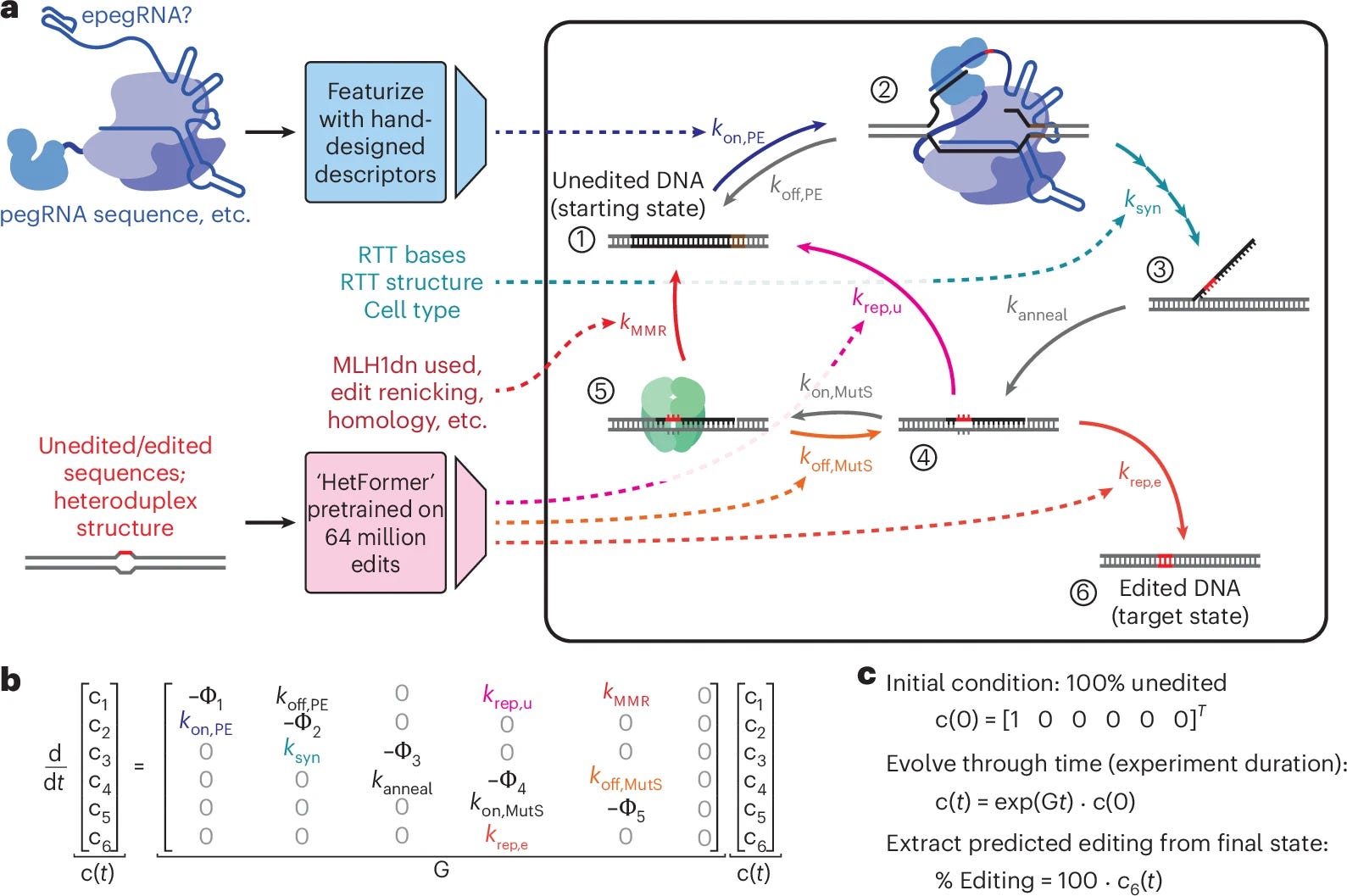
While the authors evaluated OptiPrime’s performance across many axes, its most interesting results were on out of distribution tasks such as predicting PE3 efficiency. PE3 is a prime editor that conventional efficiency prediction models struggle to score; however, relatively simple tree models built on top of OptiPrime’s predicted pseudorates yielded much stronger correlations. Furthermore, ablation studies showed that removing pseudorates once again reduced the model’s predictive power, demonstrating the benefits of OptiPrime’s mechanistic design. Similarly, the authors showed that OptiPrime’s predicted rates could also be used to better predict efficiency for twinPE (also out of training distribution) systems that use two pegRNAs and do not generate the same MMR heteroduplex structure. Finally, they used OptiPrime to optimize a PE system for a mouse model of KIF1A-associated neurological disorder. The entire process spanned four weeks of raised efficiency from 10% to nearly 60% and spanned only 15 pegRNAs which was a significant decrease from the hundred per edit in prior work. When the optimized PE was delivered to newborn mice using an AAV injection into the brain ventricles, the authors observed 40% editing in bulk cortex regions and above 70% after four weeks. In summary, this work demonstrates the potential of mechanistically-informed ML models to improve the speed and cost of optimization and design campaigns for prime editors. It will be interesting to see follow up experiments that measure the actual recovery of mice to validate the clinical impact of optimized PEs beyond simple editing efficiency.
Engineered protein circuits for cancer therapy [Lu et al., bioRxiv, August 2026]
Why it matters: RAS mutations are among the most common oncogenic alterations in cancer. RAS inhibitors reduce signaling from mutant or active RAS through pathways such as RAF-MEK-ERK (a canonical mitogenic cascade), but pathway suppression does not guarantee tumor cell elimination – mutant-RAS cells may remain viable and adapt. Lu et al. circumvent this by developing a circuit that uses bound, mutant RAS to trigger reassembly of a split protease, which in turn activates caspase-3 or gasdermin-A – causing apoptosis or inflammatory pyroptosis (e.g. encoding cell death as the output). While earlier protease circuits were capable of rerouting experimentally-elevated RAS activity to synthetic outcomes, they relied on ectopic pathway activation or RAS overexpression in cultured cells. Here, the team extends this foundation into native cancer contexts, with their circuit demonstrating endogenous mutant RAS selectivity, cell death execution after mRNA-LNP delivery, suppression of mouse liver tumors, and no potency loss in two-month-long resistance-selection experiments.
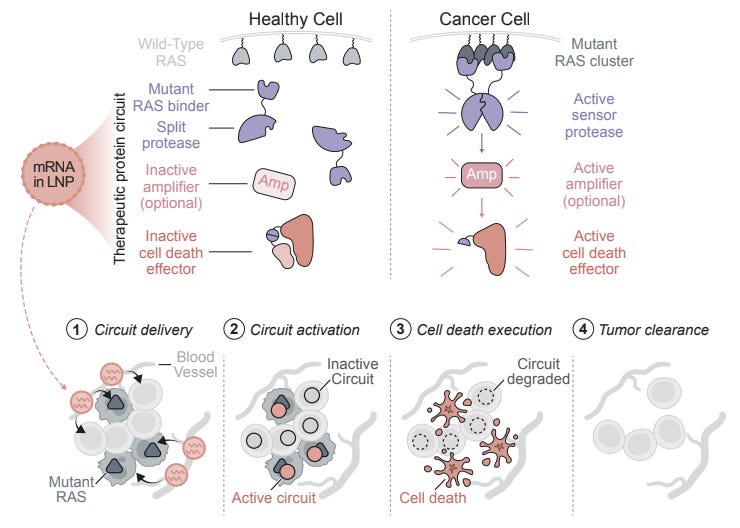
To construct the RAS sensor, the team screened natural and engineered RAS binders and chose 12VC1 – a monobody selected for mutant KRAS (G12C) over wild-type. One 12VC1 copy is fused to each half of TEV protease, so binding to membrane-localized mutant RAS brings the fragments into proximity and restores TEV activity. Weakening RAS membrane anchoring reduced sensor activation, whereas disrupting RAS clustering interfaces had little effect, suggesting that membrane localization (not high-order-clustering) is the primary requirement. To improve sensitivity, the authors expressed both sensor halves from one self-cleaving polyprotein and introduced mutations to raise TEV catalytic activity. In addition, they included and evaluated an optional second protease stage – TEV-activated TVMV protease amplifier (for weak inputs). The sensor designs detected diverse mutations across KRAS, NRAS, and HRAS – including endogenous KRAS G12C or KRAS G12V in three cancer lines – with minimal activation in five wild-type RAS lines. Replacing 12VC1 with a KRAS G12D-selective binder redirected the sensor accordingly. Most importantly, the optimized sensor closed the sensitivity gap of the original RAF1-based sensor, which responded to RAS overexpression but not endogenous mutant RAS. Sensor and effector (caspase-3 or gasdermin-A) mRNAs were packaged in separate LNPs and co-delivered. The complete circuit caused near-complete, dose-dependent death in several mutant-RAS lines, while either component alone was broadly tolerated over the tested doses.
In immunocompetent mice with multifocal liver tumors (NRAS G12V-driven disease), repeated intravenous mRNA-LNP doses strongly suppressed tumor burden and promoted clearance (without needing the amplifier). In a separate KRAS G12C model, treatment started on day 10, after tumors are visible and histologically confirmed. By day 18, treated animals had lower liver-to-body-weight ratios and fewer surface nodules than untreated day-18 controls. This cross-sectional comparison is consistent with, but not longitudinal proof of, regression. A TEV reporter provided an important specificity control: circuit activation occurred only in GFP-marked tumor cells, but not in the surrounding liver or in healthy animals.
Head-to-head experiments explain why this approach behaves differently from RAS inhibition. Sotorasib and RMC-7977 (proxy for daraxonrasib) strongly reduced ERK phosphorylation – a readout of the RAF-MEK-ERK growth pathway – in some mutant-RAS lines without killing them. The team’s circuit activated its own death machinery and eliminated both RAS-addicted (dependent on RAS signaling for survival) and non-addicted cells. A split-luciferase displacement assay further showed that the circuit can eliminate cells at a notably lower relative RAS occupancy level than the inhibitors, given one reconstituted protease can activate multiple effector molecules, whereas each inhibitor neutralization of RAS is one-to-one. In an engineered KRAS (G12V) abundance titration, increasing RAS expression reduced inhibitor efficacy but strengthened circuit killing: at a fixed drug dose, extra RAS increases the amount of target to be occupied – for the circuit, it produces more opportunities for protease activation. After two months of selection in MIA PaCa-2 (pancreatic cancer) cells, inhibitor-treated cultures acquired 5 to 57-fold losses in potency, whereas three independently circuit-selected cultures showed no significant change. The circuit also remained active against tested inhibitor-resistant KRAS variants and after overexpression of MEK1, CCND1, YAP1, or SHOC2 – changes that restore proliferative signaling downstream of or around RAS inhibition. In an RMC-7977-resistant lung cancer xenograft, intratumoral circuit delivery induced tumor-cell death and suppressed growth while oral RMC-7977 did not.
The results remain bounded by delivery and safety. Systemic efficacy is demonstrated in the liver – an organ readily reached by current LNPs. Other considerations include the treatment requiring multiple mRNAs to enter the same cell and possibly producing immunogenicity (via viral protease use) or harmful inflammation (via pyroptosis). However, the paper establishes a modular circuit with robust capabilities – endogenous mutant RAS discrimination, selective activation in tumor cells, and cell death execution even in settings that blunt RAS inhibitors.
Learning millisecond protein dynamics from what is missing in NMR spectra [Wayment-Steele et al., Nature, August 2026]
Why it matters: Protein function depends on dynamics across multiple timescales, yet our ability to predict these motions remains far behind static structure prediction, largely because protein dynamics lacks the large, standardized experimental datasets that enabled AlphaFold. This paper finds a clever source of training data hiding in decades of NMR experiments. By treating missing NMR assignments as noisy proxies for microsecond-to-millisecond (µs–ms) conformational exchange, the authors train a model that predicts functionally important protein dynamics directly from sequence and structure.
Wayment-Steel et al. first curated RelaxDB, 133 NMR relaxation datasets containing direct measurements of µs–ms conformational exchange, and found that dynamically exchanging residues are particularly evolutionarily conserved. To obtain data at scale, they reason that µs–ms motion can broaden NMR signals beyond detection, meaning residues without chemical-shift assignments can serve as noisy labels for dynamics. This expands the training set to roughly 10,000 proteins in the BMRB, orders of magnitude more information than explicitly annotated relaxation datasets.
Using these missing assignments, the authors train Dyna-1, a deep-learning model built on sequence and structural representations from ESM-3. Dyna-1 generalizes beyond its training objective – when evaluated against independent NMR relaxation experiments, it predicts residues with directly measured conformational exchange, suggesting the model has learned underlying signatures of µs–ms dynamics. Performance remains robust after removing close sequence and structural homologues from training.
The strongest predictions center around functionally important dynamic regions, including sites involved in enzyme catalysis and ligand binding, consistent with the authors’ observation that exchanging residues are more conserved. Dyna-1 also helps reinterpret existing NMR experiments: some apparent prediction errors correspond to dynamics obscured by experimental conditions or conventional relaxation analysis, while new prospective NMR measurements validate predicted exchange in previously uncharacterized proteins.
Overall, this work turns a historical experimental blind spot (what’s missing from NMR spectra) into a scalable source of protein dynamics data. By extracting dynamics labels from thousands of existing experiments, we see a path towards learning functionally relevant protein motions at a scale closer to modern structure prediction.
Programmable design of synthetic plant immune receptors for pathogen protein recognition [Zhu et al., Science, July 2026]
Why it matters: De novo protein design has proved itself in vitro and in human therapeutic applications - and has now arrived in agriculture. Zhu et al. use AlphaFold 3 and BindCraft to design binders against plant pathogen proteins of interest, then graft them into a rice immune receptor to build synthetic plant immune receptors (SPIRs), enabling proactive defense against costly plant pathogens.

Plants defend themselves largely through resistance (R) genes, most of which encode NLRs — intracellular receptors that recognize effector proteins secreted by pathogens and trigger the hypersensitive response (HR), a programmed cell death that walls off infection. Unlike the human adaptive immune system, which recombines a limited germline set into enormous antibody diversity, plants have no somatic recombination - the immune repertoire is essentially hardcoded in the genome. Any given plant genome encodes a finite set of NLRs, and deploying a new one means finding a natural receptor that recognizes your pathogen, then crossing it into an elite variety over years, all while the pathogen continues to evolve. Modern monoculture makes that race more urgent, and for viruses in particular there’s no chemical (fungicide/bactericide) fallback. The bill is substantial: plant viruses account for nearly half of emerging plant diseases and an estimated $30 billion in annual losses worldwide, with cassava mosaic and brown streak diseases alone running $2–3 billion a year. Breeders have responded by stacking multiple R genes to slow pathogen escape, but the bottleneck is the same - you can only stack R genes that evolution has already built.
SPIRs sidestep that constraint by borrowing an architecture plants already use. A subfamily of non-canonical NLRs carries a compact “integrated decoy” (ID) domain that binds effectors directly and hands the signal to a helper NLR; in the rice Pikm-1/Pikm-2 pair, the sensor Pikm-1 recognizes a blast fungus effector through an integrated heavy metal-associated domain. The authors treat that ID as a swappable socket - the analogy on the CAR side would be the extracellular antigen-binding domain. Just as we now build synthetic heads for CAR-T, the authors realized they could design custom binders, swap them into the ID, and generate an entirely new synthetic plant immune receptor. For a target of interest, they predict the pathogen protein’s structure with AlphaFold 3, generate binders with BindCraft, double check the binder structures with HelixFold 3, and graft the survivors into the Pikm-1 scaffold. Of 391 SPIRs tested, 18% worked while 58% were autoactive, firing without any pathogen present - analogous to tonic signaling in CAR-Ts. Since nobody fully understands how Pikm-1 activation is triggered, the authors couldn’t rationally design this away. They leaned into directed evolution instead, screening a library of SolubleMPNN-diversified binder variants with GRAPE, their in planta directed evolution platform. The trick is that a firing SPIR kills its own cell and suppresses the geminivirus replicon carrying it, so variants depleted only when the target is present are exactly the well-behaved ones. It worked in both directions: six of seven variants rescued a weak-but-clean receptor, and six of seven stripped the autoimmunity from a potent-but-leaky one.
The results are promising. Infectious clones of ToBRFV, PVX, and BBWV2 all triggered immunity, and transgenic N. benthamiana expressing an evolved ToBRFV receptor resisted infection by both agroinfiltration and mechanical inoculation. A few biological quirks shaped the design space along the way. Fusing two binders in tandem within one ID broke signaling even though the fusion still bound both targets, so the decoy has a size and rigidity budget independent of recognition. Swapping in Pikp-2 as the helper NLR damped autoimmunity but also blunted the real response - the receptor pair has a tunable but coupled activation threshold. And because NLRs fire in the cytosol, targets had to be small, cytoplasmic, and confidently modeled, which for now rules out a lot of effector biology. The controls were careful too: a chimeric ToBRFV carrying a different coat protein replicated without triggering HR, and stop codons in the viral polymerase abolished both replication and the response, confirming the receptor sees protein translated from the viral genome rather than the delivery construct. Crucially, the receptors are orthogonal: in a nine-by-nine matrix of SPIRs against pathogen proteins, each responded only to its cognate target, and co-expressing several full-length SPIRs gave additive responses to each. That means the platform is expandable - breeders can keep adding new pathogens to a plant’s immune repertoire as they emerge, designing receptors in weeks rather than breeding them over years, enabling a proactive defense effort against plant pathogens.
Notable deals
Infinimmune closes a $75M Series A led by Playground Global and Regeneron Ventures. The funds will primarily be used to support the clinical development of the company’s two lead programs, IFX-101 and IFX-201, while advancing the rest of their pipeline. The lead assets—which are fully human, monoclonal antibodies developed on the company’s Anthrobody® platform—target IL-22 and IL-13 respectively for atopic dermatitis. Other investors in the round included Civilization Ventures, Everbright Biofund, Forge Life Science Partners, Godfrey Capital, Goldcrest Capital, Merck Global Health Innovation Fund, Pear VC, RA Capital Management, and Wild Tree Ventures.
Epicrispr Biotechnologies announces a $90M oversubscribed Series C led by Janus Henderson Investors and Octagon Capital. The company has used their Gene Expression Modulation System (GEMS) to develop several programmable epigenetic medicines, one of which (EPI-321) is currently in first-in-human trials for facioscapulohumeral muscular dystrophy. Funds will be used to support this Phase I/II trial, which has already yielded a favorable safety profile. Cormorant Asset Management, Duquesne Family Office, Fidelity Management & Research Company, Sanofi Ventures, funds managed by abrdn Inc., Angelini Ventures, Readout Capital, and existing investors also participated in the round.
InduPro raises a $77M Series B in a round led by The Column Group. Focusing on the treatment of cancer and autoimmune diseases, the company has just dosed their first patient in the Phase I trial for their lead program, IDP-001. The asset is a bispecific ADC which targets both EGFR and a novel Tumor-Associated Proximity Antigen which is intended to be used to treat advanced or metastatic squamous or non-squamous non-small cell lung cancer. Other participants in the raise were Eli Lilly and Company, Emerson Collective, Euclidean Capital, MRL Ventures Fund, Sanofi, Solasta Ventures, and Vida Ventures.
Jazz Pharmaceuticals announces the acquisition of Actio Biosciences for $820M. The agreement mainly focuses on Actio’s lead asset ABS-1230, which is a first-in-class KCNT1+ epilepsy treatment. It is currently in Phase Ib/IIa trials with FDA Fast Track, Orphan Drug Product designations, and Rare Pediatric Disease. The deal also includes an additional $500M in milestones and the spinning out of a new company from Actio focusing on rare neurological diseases in which Jazz will have a minority stake.

In case you missed it

What we liked on socials channels


Events

Field Trip
Did we miss anything? Would you like to contribute to Decoding Bio by writing a guest post? Drop us a note here or chat with us on Twitter: @decodingbio.